_edited.png)
Baby Proofing Your Indian Home: The Complete Room-by-Room Guide (2026)
Updated: Sep 22

NavParent Verdict Western baby-proofing checklists miss half of what matters in an Indian home. Bucket drowning, inverter rooms, pooja room diyas, window grilles, floor-level cooking — none of these appear in any imported guide. This one is built for Indian homes specifically. |
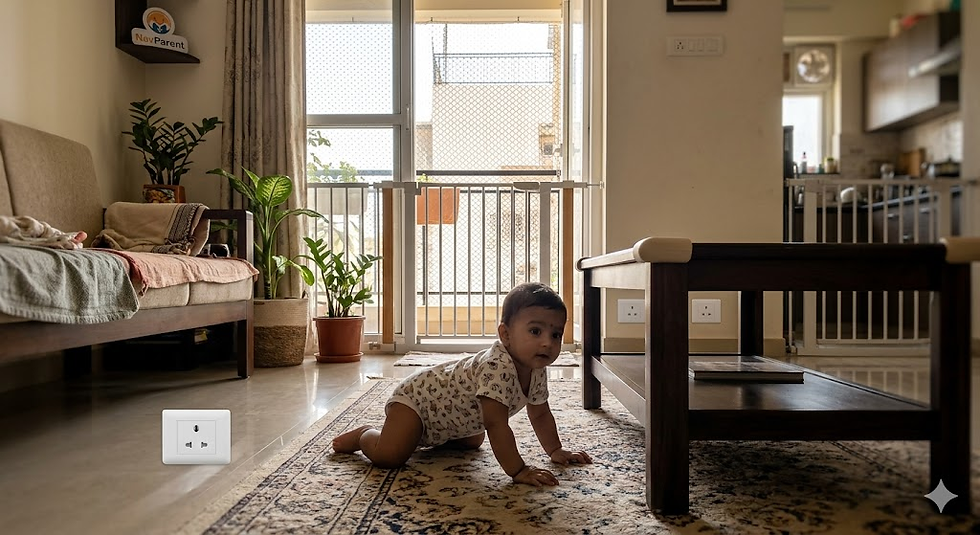
Start before they move — not after
Every parent waits too long. Baby-proof at 4 months, before your baby can roll. The minimum spend to address every critical hazard in this guide is ₹2,500–4,000. That is a one-time cost. The alternative is an emergency room visit that costs significantly more — and that is the optimistic outcome.
⚠ Do the critical items first. Bucket water, inverter room, electrical sockets, bed falls, and kitchen access. These five items cause the majority of serious baby injuries in Indian homes. Do them this week, regardless of where you are in reading this article. |
The complete India baby-proof checklist — at a glance
Hazard | Risk Level | India-Specific? | Fix | Cost |
Bucket standing water | CRITICAL | Yes | Lock bathroom; empty buckets | ₹80–200 |
Inverter/battery room | CRITICAL | Yes | Locked door at all times | ₹80–200 |
Pooja room diyas/camphor | CRITICAL | Yes | Gate; raise lit items above 1.2m | ₹400–1,200 |
Terrace / rooftop door | CRITICAL | Yes | Locked; key out of reach | ₹0 |
Window grilles / balcony | CRITICAL | Yes | Check spacing; window stops | ₹200–500 |
Kitchen access during cooking | CRITICAL | Yes | Baby gate — no exceptions | ₹400–1,200 |
Bed falls (family bed) | CRITICAL | No | Floor mattress or bed rail | ₹800–2,000 |
Exposed electrical sockets | CRITICAL | No | Socket covers on all sockets | ₹80–200 |
All medicines | CRITICAL | No | Locked box or above 1.5m | ₹300–600 |
Lower cabinet contents | HIGH | No | Magnetic cabinet locks | ₹150–400 |
Furniture sharp corners | HIGH | No | Corner guards | ₹200–400 |
Visitors' handbags | HIGH | Yes | House rule: bags above 1m | ₹0 |
⚠ Minimum total spend for all CRITICAL fixes: ₹2,500–4,000. Do these before your baby rolls — not after. |
The Indian home hazards no Western guide covers
Before the room-by-room breakdown, here are the four hazards that are entirely India-specific and almost never appear on imported safety checklists:
Bucket drowning — every Indian bathroom has standing water in buckets. A baby can drown in 5cm of water in under 2 minutes, silently. This is one of the leading preventable causes of infant death in India.
Inverter / UPS battery room — lead-acid batteries contain sulphuric acid. The inverter cupboard or room in most Indian homes is unlocked and completely unsecured. Acid contact causes severe chemical burns.
Pooja room — diyas, lit agarbatti, camphor flames, and small metal idols, all at floor or low-shelf level. A crawling baby can reach a lit diya in seconds.
Window grilles — Indian window grilles with horizontal bars are ladders for toddlers. A child can climb through a gap that looks too small. This is a fall risk that does not exist in most Western homes.
The kitchen — highest risk room in every Indian home
Kitchen access gate — non-negotiable from 6 months
The single most important thing you can do for kitchen safety. A baby gate blocking kitchen entry during cooking prevents access to hot surfaces, steam burns, cooker handles at crawling height, and floor-level cooking setups.
Cost: ₹400–1,200 for a baby gate
When: Install before 6 months — as soon as your baby is showing signs of mobility
Floor-level cooking
Western safety guides assume elevated cooktops. Indian floor-level cooking — sigri, floor gas burners, angithi — places hot surfaces directly within crawling reach. This is a unique and critical hazard. The fix is the same as above: no baby in the kitchen during cooking. Ever.
Lower cabinet contents
Indian kitchen lower cabinets typically contain a mix of food, cleaning products, and sharp tools — often in the same cupboard. Babies find every unlocked door by 8 months.
Fix: Magnetic cabinet locks on every lower door. Move all cleaning chemicals to high shelves. A pack of magnetic locks costs ₹150–400 and covers an entire kitchen.
Appliance cords
Mixer-grinder cords, kettle cords, and toaster cords hanging over counter edges are pull hazards. A mixer-grinder pulled off a counter by its cord can cause serious crush and burn injury to a baby below.
Fix: Cord clips to keep cables back from edges. Unplug all appliances when not in use — ₹100–200 for cord organisers.
The bathroom — the room parents underestimate most
Bucket drowning — the hazard that is entirely preventable
Say this clearly: a baby or toddler can drown in as little as 5cm of water in under 2 minutes, silently. They fall forward into the bucket and cannot push themselves back up. Their lungs fill before they can make a sound.
Every Indian bathroom has at least one bucket of standing water. This is one of the most common causes of preventable infant drowning in India.
Fix: Empty all buckets after every use. If you must store water for power cut preparation, the bathroom door must be locked with an adult-height hook latch at all times when a baby is in the home.
Cost: ₹80–200 for a door hook latch
Geyser / water heater temperature
Set your geyser thermostat to 49°C maximum. At this temperature, water can still cause a scald burn but requires 10+ minutes of contact. Above 60°C, a scald burn happens in under 5 seconds. Most Indian geysers are set higher than necessary.
Cost: ₹0 — a thermostat adjustment
Medicines in accessible locations
All medicines — your own, your partner's, grandparents', and visitors' — must be in a locked box or above 1.5 metres height. Child-resistant caps slow a child down. They do not stop them. Cardiac medications and blood pressure tablets are among the most dangerous substances a toddler can ingest.
Cost: ₹300–600 for a lockable medicine cabinet
Living room and bedroom
Bed falls — the #1 cause of infant head injury in India
Most Indian babies sleep on the family bed. A rolling baby at 5 months falls off a family bed silently — there is no warning. Bed falls are the single most common cause of infant head injury presenting to Indian paediatric emergency rooms.
Best fix: Move to a floor mattress from 4 months — eliminates the fall entirely
Alternative: Bed rail on the open side, wall on the other, with no gap between mattress and wall or rail
Cost: Bed rail ₹800–2,000
Electrical sockets
Indian homes have many sockets at floor level with no internal shutters — standard Indian sockets are open. Babies insert fingers and objects into sockets from around 8 months.
Fix: Socket covers on every accessible socket — the cheapest safety fix in this entire guide at ₹5–10 each
Cost: ₹80–200 for a full pack
Glass-top furniture and sharp corners
Glass-top coffee tables shatter and lacerate. Sharp furniture corners are at exactly head height for a pulling-to-stand baby. Corner guards on all accessible furniture and removal of glass-top tables until age 2 are both easy fixes.
Cost: ₹200–400 for a corner guard set
India-specific hazards: the complete list
Inverter / UPS battery room
Lead-acid batteries — the type in every Indian home UPS system — contain sulphuric acid. Contact with acid causes immediate, severe chemical burns. The inverter cupboard or room is typically unlocked, unlit, and at ground level — invisible to parents as a hazard until it is not.
Fix: Locked door with an adult-height hook latch. This is non-negotiable.
Cost: ₹80–200
Pooja room
Diyas and oil lamps, lit agarbatti, camphor flames, and small metal idols are all typically at floor or low-shelf level in Indian pooja rooms. A crawling baby is at exactly the right height to touch a flame or ingest camphor — which is toxic.
Fix: Baby gate or closed door during puja. All lit items above 1.2m when baby is mobile.
Window grilles with horizontal bars
Indian window grilles designed with horizontal bars create a climbing structure for toddlers. A child can climb higher than you expect and fall through a gap that looks too narrow. Check grille bar spacing — under 10cm vertical gap with no horizontal rungs is the safe standard. Add window stops on all opening windows above ground floor.
Cost: Window stops ₹200–500
Terrace / rooftop access
Many Indian homes have rooftop terraces accessed by an unlocked internal door. A toddler who reaches an unsecured terrace and the parapet wall is in immediate fall danger. The terrace door must be locked at all times when a toddler is in the home, with the key stored out of reach.
Cost: ₹0 — key discipline
Joint family homes and domestic help
Visitors' handbags — an overlooked hazard
Handbags left on the floor by visitors and relatives contain coins, medicines, pins, lighters, and small objects. A toddler will empty a handbag in under 60 seconds. Establish a house rule: all bags go above 1 metre height immediately on entering. Apply this to family members, in-laws, and visitors without exception.
Grandparents' medicines
Elderly family members frequently carry heart medications, blood pressure tablets, and diabetes medicines. Some of these — particularly cardiac medications — can be fatal to a toddler in a single dose. This conversation is worth having even when it feels awkward. All family member medicines must be in a locked box.
Domestic help briefing
Your bai or nanny may not know what baby-proofing means. Do not assume knowledge. Walk through the specific hazards of your home together. Show them where cleaning products are stored and why they must stay there. This is your responsibility, not theirs.
Choking: what to know and what to do
The test for choking hazards: anything that fits through a toilet roll tube is a choking hazard. Anything smaller than a 50-paise coin is a choking hazard. Do a floor-level sweep of every room your baby accesses — get on your hands and knees and look at the floor from their perspective.
Indian foods to modify under 2 years
• Whole grapes — always cut lengthwise into quarters
• Cherry tomatoes — cut into quarters
• Whole nuts — ground or smooth nut butter only
• Hard chunks of raw carrot or apple — cook soft or grate
• Whole moong or chana — mash or serve as dal
• Fish with small bones — debone meticulously before serving
• Large pieces of roti — tear into small pieces for under-18 month babies
If your baby is choking — what to do
If they are coughing effectively: do not interfere. Coughing is the body's mechanism and it works.
If they cannot cough, cry, or breathe — act immediately:
Under 1 year: 5 firm back blows between shoulder blades (baby face-down on your forearm), then 5 chest thrusts
Over 1 year: 5 back blows then 5 abdominal thrusts (modified Heimlich)
Call 112 emergency services while continuing
Do NOT do blind finger sweeps in the mouth — this can push the object deeper
⚠ Learn infant CPR and choking response before your baby is mobile. IAP and the Red Cross Society of India both offer 3-hour courses in major Indian cities. This is the one preparation that matters most. |
Frequently asked questions
When should I start baby-proofing?
4 months — before your baby can roll. Every family waits too long. The transition from rolling to crawling to pulling-to-stand happens in 2–3 months. Baby-proof before the first roll, not after the first fall.
Do I need to buy expensive safety products?
No. The most critical fixes in this guide cost ₹80–200 each. The total for all CRITICAL items is ₹2,500–4,000. The most important fixes — empty buckets, lock the inverter room, store medicines high — cost nothing at all.
My in-laws say we were fine without baby-proofing. How do I handle this?
Frame it as 'our paediatrician specifically told us to do these things.' This is both true and reduces the personal dimension of the conversation. You are not questioning their parenting — you are following medical guidance. Most family members accept this framing readily.
What is the single most important thing to do first?
Empty every bucket of standing water in your home right now. Today. Before anything else. This is the fastest, cheapest, and most immediately impactful change you can make.
Sources & references
• IAP (Indian Academy of Pediatrics) — child safety and injury prevention guidelines
• WHO — home injury prevention and drowning prevention reports
• AIIMS — paediatric emergency and burns data India
• Red Cross Society of India — infant first aid and choking response protocols
• NHTSA — child injury data (international comparison)
NavParent.com | India's most trusted baby & toddler product review platform


Comments