_edited.png)
How to Work From Home While Taking Care of Young Children
- Jul 7
- 4 min read
Working from home with young children is about parents building three things: a predictable routine, clear boundaries with children, and realistic expectations of themselves.
WFH with young children is one of the most searched and least honestly answered topics in parenting. Most advice either ignores the reality of toddlers or suggests solutions that require a nanny and soundproof office. This guide is for the majority, parents managing real children in real homes.
Why It's Harder Than It Looks
Children under 5 have no concept of "Mama is working." They see you, they want you. Every time. Your presence triggers a need for connection.
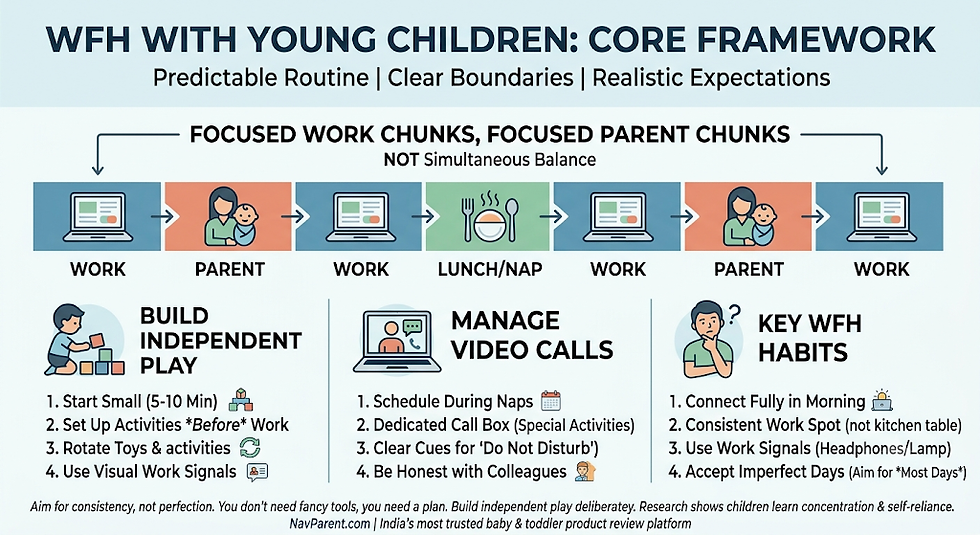
The Core Framework: Chunks, Not Balance
Work in focused chunks and parent in focused chunks.
Sample structure for a toddler at home:
Time | What Happens |
6:00–7:30 AM | Work before child wakes (most productive block) |
7:30–9:00 AM | Morning routine, breakfast, connection time |
9:00–11:00 AM | Independent play / activity set up, work at home desk |
11:00–11:30 AM | Snack, reconnect, prepare lunch activity |
11:30 AM–1:30 PM | Lunch + nap = second focused work block |
1:30–3:30 PM | Post-nap connection + low-key activity |
3:30–5:30 PM | Work if partner is home / third block |
Evening | Family time, no work |
This won't work every day. It works most days, which is the goal.
Setting Up Independent Play (Your Most Valuable Tool)
Independent play — where your child plays without needing you is a skill you build deliberately. And it's the single biggest enabler of WFH productivity.
How to build it:
• Start with just 5–10 minutes and increase gradually
• Set up the activity before you need to work, not when you're already in a meeting
• Use a "work signal" — same spot, same lamp on, same visual cue — so children learn what it means
• Don't interrupt independent play to check in — this breaks the habit you're trying to build
• Rotate toys and activities so they feel fresh
Activities that reliably hold attention for 20–30 minutes:
• Playdough with tools and cutters
• Water play (bathroom floor, large basin)
• Building blocks or Duplo
• Play kitchen or tea set
• Sensory bin (rice, dried lentils, sand)
• Drawing with new markers or stickers
Managing Video Calls
The fear of children appearing on calls is universal. Practical solutions:
• Schedule important calls during nap time whenever possible
• Set up a dedicated activity box — opened only during calls, making it feel special
• Tell your child explicitly: "I have a call for 30 minutes. When the light is on, I cannot be interrupted unless you're hurt."
• Brief your colleagues if you have a toddler — most people understand and appreciate honesty over a scramble
• Have a backup activity ready (tablet as absolute last resort — not ideal but real)
If your child interrupts a call, handle it calmly. Panicking or snapping makes it worse. A calm "I'm on a call, please wait" and pointing to their activity works better than it should.
What Doesn't Work (Common Mistakes)
Trying to work while entertaining your child simultaneously. You'll do neither well. Choose one.
Expecting toddlers to "understand" why you're busy. They don't. They just know you're there and not available. Create physical or visual distance when working.
Saving all screen time for work emergencies. If screens are the only tool in your emergency kit, they lose effectiveness fast. Build independent play first.
Skipping the morning connection. Children who get focused connection in the morning tolerate independent time better during the day. 20 minutes of full-attention play pays for itself in hours of calm.
When You Have Multiple Children
With two or more children, the dynamic shifts — older children can often entertain younger ones, but they also create more noise and conflict.
• Pair children for activities (older reads to younger, older "teaches" younger a game)
• Stagger nap times if possible to create two separate quiet windows
• Give the older child responsibility during work blocks — they respond to being trusted
• Outdoor time before your first work block burns energy and buys quiet time
Practical Setup at Home
You don't need a home office. You need a consistent spot that signals "work mode" to both you and your child.
• Same chair or desk every time
• A visual cue (lamp on, headphones on) that means "do not disturb"
• Ideally, not the kitchen table — too much family traffic
• Noise-cancelling headphones are one of the best investments for WFH parents
Frequently Asked Questions
My toddler won't let me work at all. What do I do?
Start smaller. Five minutes of independent play. Build from there. If your child has never had to self-entertain, it takes 1–2 weeks of consistent practice before it becomes a habit. Don't give up after one bad day.
Should I use screen time to buy work time?
Strategically, yes. Screens as a daily crutch — multiple hours to cover work — creates dependency and is not developmentally ideal. One 30-minute block during your most critical work period is reasonable. Build other tools so screens aren't your only option.
Is it realistic to WFH full-time with a toddler and no other childcare?
Honestly — for most parents, not at full productivity. Many WFH parents in India combine WFH with part-time daycare (morning crèche), grandparent support for a few hours, or staggered schedules with a partner. Full WFH without any childcare support works for part-time or flexible roles, not typically for demanding full-time positions.
How do I handle guilt when I can't give my child attention?
Reframe: children who learn to play independently develop concentration, creativity, and self-reliance. You are not neglecting your child by working. You are also modelling something important.
Quick Summary
• Work in focused chunks, not simultaneous balance
• Build independent play before you need it — it's a skill, not a given
• Morning connection time pays off in afternoon calm
• Use visual/physical cues to signal work mode to your child
• Full WFH with a toddler and zero childcare support is hard — most families supplement with some external help
NavParent.com | India's most trusted baby & toddler product review platform


Comments