_edited.png)
Introducing Solids to Your Baby in India 2026: BLW Guide + Best Products for First Foods
Updated: Sep 22

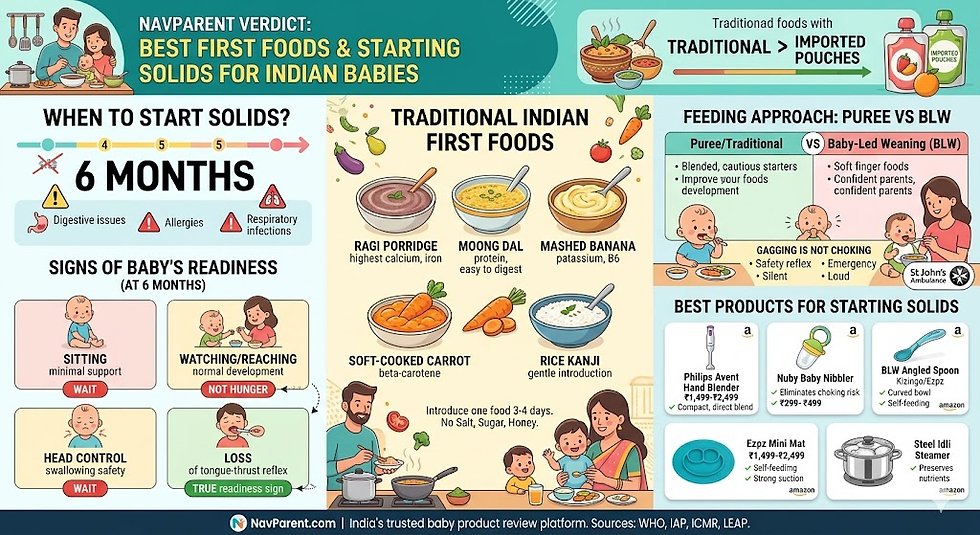
NavParent Verdict The best first foods for Indian babies are not imported pouches — they are ragi porridge, mashed banana, moong dal water, and soft-cooked vegetables that your kitchen already makes. For equipment, the Philips Avent Hand Blender (₹1,499–₹2,499) and a Nuby Baby Nibbler (₹299–₹499) are useful purchases. Everything else is optional. |
When to start solids
6 months. Not 4. Not 5.
⚠ Starting solids before 6 months increases the risk of allergies, digestive issues, and respiratory infections. |
Readiness Sign | What It Means | Action |
Sitting with minimal support | Developmental milestone — appropriate to start soon | Wait until full 6 months |
Watching adults eat / reaching for food | Normal development from 4 months — not a hunger signal | Do not start early |
Seeming unsatisfied after feeds | Usually a growth spurt or developmental leap | Increase feed frequency |
Head control — can hold head steady | True readiness sign — needed for safe swallowing | Still wait for 6 months |
Loss of tongue-thrust reflex | True readiness sign | Can begin at 6 months |
Traditional Indian first foods — the best options
Indian first foods are nutritionally excellent — the problem is that many Indian parents now distrust traditional foods in favour of imported pouches that are more expensive and often less nutritious. These are the best first foods available in any Indian kitchen:
Ragi (finger millet) porridge: Highest calcium content of any cereal grain. Iron-rich. Digestive-friendly. Thin consistency for first attempts, thicker as the baby adapts. Cook, blend, strain.
Moong dal water: Well-cooked yellow moong dal, blended and strained. Protein-rich, easy to digest, naturally mild.
Mashed banana: No cooking required. Natural sweetness makes it an easy first food. Rich in potassium and B6.
Soft-cooked carrot / sweet potato: Steam until very soft, blend or mash. Rich in beta-carotene.
Rice kanji: Rice cooked to a very thin porridge consistency. Gentle introduction, widely used across India.
Introduce one new food every 3–4 days. This allows identification of any allergic reaction before adding the next food. Do not add salt, sugar, or honey to any food before 12 months — honey specifically can cause infant botulism and is strictly contraindicated before 1 year. |
Traditional Puree vs Baby-Led Weaning (BLW) — the honest comparison
Approach | How It Works | Best For | Key Risk | NavParent View |
Puree / Traditional | Blended smooth foods, spoon-fed | Families new to solids, cautious starters | Delay of chewing skill development if purees continue too long | Excellent starting point — transition to soft finger foods by 8–9 months |
Baby-Led Weaning (BLW) | Soft finger foods from 6 months, baby self-feeds | Confident parents, babies with good motor control | Gagging concern (normal) vs choking (rare but serious) | Valid approach — learn the difference between gagging and choking first |
Combination approach | Purees + appropriate finger foods simultaneously | Most Indian families | None specific | Recommended by most Indian paediatric dietitians |
Gagging is not choking. Gagging is a loud, retching response — it is a safety reflex working correctly, not a choking event. Choking is silent, with a blue face and inability to cry. Every parent starting BLW should watch the Gagging vs Choking video from St John's Ambulance before the first BLW session. |
Best products for starting solids
1. Philips Avent Hand Blender — Best Blender for Baby Food
Price: ₹1,499–₹2,499 | Best for: Smooth purees for 6–8 month stage, blending small quantities
✓ Pros | ✗ Cons |
✓ Compact — blends directly in the cooking pot or bowl, no separate jar to clean | ✗ Single-speed models less effective for very fibrous vegetables (drumstick, raw jackfruit) |
✓ Variable speed for fine-tuning puree consistency | ✗ No steaming function — blending and steaming are separate steps |
✓ Easy to clean — detachable blending shaft dishwasher-safe | ✗ Not suitable for making large batches efficiently |
✓ Suitable for long-term family use, not just baby stage |
|
2. Nuby Nibbler / Silicone Feeder — Best for BLW Beginners
Price: ₹299–₹499 | Best for: Introducing soft foods safely, 6–9 months, reducing parental choking anxiety
A nibbler is a mesh or silicone net attached to a handle — the baby chews on the net, food comes through in tiny pieces, and large chunks cannot pass. It is the ideal bridge between purees and full BLW. Put a piece of ripe mango, banana, or soft-cooked carrot inside and let the baby explore taste and texture safely.
✓ Pros | ✗ Cons |
✓ Eliminates choking risk while introducing real food textures | ✗ Mesh versions are harder to clean thoroughly — silicone is preferable |
✓ Baby controls the feeding pace — promotes self-feeding confidence | ✗ Baby loses interest around 9–10 months as self-feeding ability improves |
✓ Easy to clean — mesh/silicone net removes for washing | ✗ Not a long-term feeding solution — a transitional tool only |
✓ Inexpensive — best value per use of any feeding equipment on this list |
|
3. BLW Spoon (Kizingo or Ezpz) — Best Spoon for Self-Feeding
Price: ₹299–₹599 | Best for: 6 months+, self-feeding from the start
A standard baby spoon is straight — which requires adult wrist mechanics to use correctly. A BLW spoon has an angled or curved bowl that a baby can successfully get food into their mouth with the motor skills available at 6–8 months. The difference between a frustrated baby throwing a spoon and one who successfully gets food to their mouth is often just the spoon shape.
✓ Pros | ✗ Cons |
✓ Angled bowl compensates for undeveloped wrist rotation — babies succeed sooner | ✗ Higher price than standard baby spoons |
✓ Silicone tip safe for gums and emerging teeth | ✗ Some designs available only online — not in physical Indian retail |
✓ Promotes independence and motor skill development from the first meal | ✗ Baby will still throw it — repeatedly — regardless of quality |
✓ Soft enough that vigorous self-hitting with the spoon does not cause injury |
|
Price: ₹1,499–₹2,499 | Best for: 6 months+, reducing plate-throwing, self-feeding
✓ Pros | ✗ Cons |
✓ Strong suction — significantly harder for baby to throw off the high chair tray | ✗ Only works on smooth high chair trays — does not suction on textured or fabric surfaces |
✓ All-in-one mat and plate — nothing to separate or lose | ✗ Limited colour choices |
✓ Food-grade silicone — no BPA, lead, or PVC | ✗ Price is high for what is essentially a suction plate — but the reduction in food-on-floor is worth it for many parents |
✓ Dishwasher safe, microwave safe |
|
Price: ₹499–₹999 | Best for: Steaming vegetables and eggs for baby food — preserves more nutrients than boiling
The most underrated baby food tool in India is one already in most Indian kitchens: the idli steamer. Steaming vegetables preserves up to 50% more vitamins than boiling in water. For families without a dedicated steamer, a standard Indian pressure cooker with a steaming plate accomplishes the same thing. No special purchase needed if you already have one.
✓ Pros | ✗ Cons |
✓ Steaming preserves significantly more nutrients than boiling — especially water-soluble vitamins | ✗ Steaming takes longer than boiling — less convenient for quick weekday meals |
✓ Most Indian families already own a steaming vessel — zero additional purchase needed | ✗ Requires supervision — steam burns are a serious kitchen hazard |
✓ Versatile: same vessel used for idli, dhokla, and steamed vegetables |
|
✓ Stainless steel — no leaching, long-lasting, easy to clean |
|
Frequently asked questions
Can I start with ragi or does it have to be rice?
Ragi is an excellent first food — there is no requirement to start with rice. The IAP recommends starting with iron-rich foods, and ragi (finger millet) is one of India's best sources of dietary calcium and iron. Prepare it as a thin, well-cooked porridge and introduce at 6 months. Many Indian paediatric dietitians now prefer ragi over rice as a first grain.
My baby gags every time I introduce a new texture. Should I go back to purees?
Gagging is normal and expected — it is a safety reflex, not a sign of readiness failure. Every baby gags when learning to manage new textures. As long as the gagging resolves quickly and the baby is not showing choking signs (silence, blue colour, inability to breathe), continue at the same pace. Going back to purees every time gagging occurs will prolong the transition to textured food and delay the development of chewing skills.
When should I introduce peanuts? I've heard conflicting advice.
The LEAP trial (Learning Early About Peanut allergy) and updated IAP guidelines now recommend introducing peanuts between 6–12 months for most babies — including those without eczema. Early introduction reduces peanut allergy risk. Introduce as thin peanut butter (mixed into food, never whole peanuts — a severe choking hazard) and watch for 15 minutes for any reaction. If baby has severe eczema, consult your paediatrician before introducing.
Do I need a food processor or will a regular mixie work?
A regular Indian mixie works perfectly for baby food — it is what most Indian grandmothers have used for decades. The limitation is that most mixies are too large to blend small quantities effectively. A hand blender (₹1,499–₹2,499) solves this: it blends directly in a small bowl or cup without needing a minimum quantity. For families who already have a mini chopper or small-jar mixie attachment, no additional purchase is needed.
Sources & references
• WHO — Complementary feeding guidelines (2023)
• Indian Academy of Pediatrics — Infant and young child feeding guidelines 2022
• Du Toit G et al. — LEAP trial, peanut allergy prevention (NEJM, 2015)
• Rapley G & Murkett T — Baby-Led Weaning (2008, updated 2019)
• ICMR — Nutrient requirements and dietary allowances for Indians, 2020
• IPF India solid foods community — 3,200+ parent discussions
Access Related Parenting Resources
Affiliate Disclosure
NavParent participates in the Amazon Associates Programme. Links marked → are affiliate links — we earn a small commission at no extra cost to you.
NavParent.com | India's most trusted baby & toddler product review platform



Comments