_edited.png)
Starting Solids in India: Complete Equipment Guide — High Chair, Blender, Nibbler, Bowls — What's Actually Necessary?
Updated: Sep 22

Starting Solids in India: The Complete Equipment Guide for Indian Families (2025)
NavParent Verdict: You do not need ₹15,000 worth of gadgets to start your baby on solids. We tested the essential equipment for Indian families — what is genuinely needed, what to skip, and which Indian brands hold up. |

When to Start: The IAP and WHO Guidance
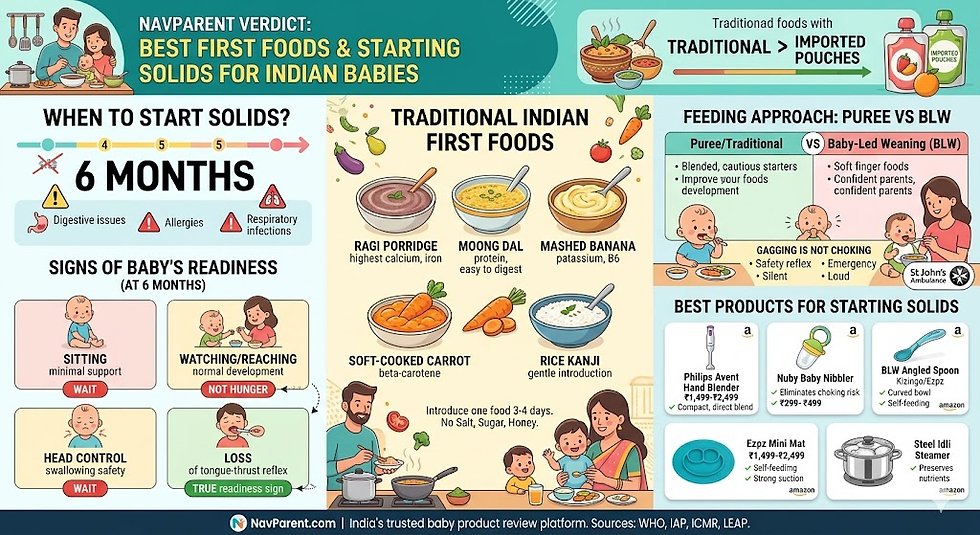
World Health Organization (WHO) and the Indian Academy of Pediatrics (IAP) recommend exclusive breastfeeding for 6 months, followed by introduction of solid foods alongside continued breastfeeding. The 6-month recommendation is firm — starting solids earlier increases the risk of respiratory infections, digestive issues, and later obesity.
Signs your baby is ready (at 6 months): sitting with minimal support, showing interest in food, losing the tongue-thrust reflex (no longer automatically pushing food out of the mouth), and holding their head steady. All 4 signs should be present — hitting 6 months on the calendar alone is not sufficient readiness.
The Indian Approach to Starting Solids
Traditional Indian weaning foods are nutritionally excellent — rice kanji, moong dal water, ragi porridge, and mashed banana have nourished Indian babies for generations. The global shift toward Baby-Led Weaning (BLW) is increasingly adopted by urban Indian parents, but traditional spoon-feeding with mashed foods is equally valid and culturally appropriate.
The most important principle: variety. Indian cuisine's diversity is an enormous asset — introduce a wide range of flavours, textures, and spices gradually from 6 months. Babies introduced to diverse flavours early are significantly less likely to become picky eaters.
The Essential Equipment List — What You Actually Need
1. High Chair — The Most Important Investment
A high chair is the single most valuable piece of weaning equipment. It positions your baby safely, keeps them focused on eating, and establishes the feeding routine. In Indian homes, it also keeps them off the floor where cleaning is more complex.
Best budget option: Chicco Polly (₹8,000–12,000) — best safety and ease of cleaning in its price range
Best value option: R for Rabbit Marshmallow (₹5,000–8,000) — strong build, easy to clean, compact
Budget option: LuvLap Comfy Baby (₹3,000–5,000) — adequate for basic use
Key features for Indian homes: easy-to-clean tray (Indian food stains), stable base for uneven floor surfaces, compact footprint for smaller Indian kitchens. Avoid high chairs with fabric inserts that require machine washing — they are impractical for Indian meal frequency.
2. Bowls and Spoons — Keep It Simple
You do not need expensive baby-specific sets. Food-grade silicone bowls and spoons are the most practical for Indian weaning.
• Silicone spoons (first stage): Soft-tip silicone spoons for first weeks. Munchkin and NUK make the best options available in India (₹200–500 for a set).
• Suction bowls: Silicone suction bowls prevent sliding during messy eating. The Bumkins and Béaba suction bowls are available on Amazon India (₹600–1,200). Avoid cheap versions — the suction often fails.
• Steel bowls: Traditional Indian steel katori — completely safe, durable, and widely available — is perfectly suitable from 8 months once babies are past the earliest soft-spoon stage.
3. Bibs — An Underrated Essential
Weaning in India is messy. Traditional Indian first foods (ragi porridge, dal, mashed sabzi) stain everything. Invest in proper bibs before you start.
• Silicone pocket bibs: The best investment — catch dropped food, easy to wipe, durable. Bumkins and Marcus & Marcus bibs are available in India (₹600–1,200 each). Worth every rupee.
• Full-sleeve weaning smocks (₹300–600): Essential for BLW and self-feeding stages — protects clothing fully. Available on FirstCry.
• Cloth bibs: Adequate for drool and light weaning but insufficient for full meals — they saturate quickly with Indian food.
4. Baby Food Processor / Blender
For the puree stage (6–8 months), you need something to blend. You do not need a dedicated baby food maker.
• What you already have: A standard Indian mixer-grinder (Preethi, Sujata, Butterfly) blends baby food perfectly well. Add a small jar or use the chutney jar. This is genuinely all most Indian families need.
• Immersion blender (₹800–2,500): The most practical additional purchase. Immersion blenders let you blend small quantities in the cooking pot — less washing up, faster process. Philips and Bajaj make reliable options available everywhere in India.
• Dedicated baby food makers (Béaba, NUK): Steam and blend in one unit. Useful but expensive (₹4,000–8,000) and not necessary given standard Indian kitchen equipment. Consider only if you prefer the convenience.
5. Freezer Trays for Batch Cooking
Batch cooking and freezing purees saves enormous time. Indian families who batch cook once per week significantly reduce daily weaning effort.
• Ice cube trays (₹100–200): Standard ice cube trays from any Indian home store work perfectly. Silicone trays are easier to pop out.
• Silicone freezer trays (OXO Tot, Munchkin): Portion-sized trays with lids. Available on Amazon India (₹800–1,500). Worth the investment for consistent portion sizes.
Batch cooking tip: Blanch and puree vegetables in batches of 20–30 cubes. Each cube is typically one tablespoon — two cubes is a first-stage meal. Freeze for up to 3 months.
6. Sippy Cups and Water Introduction
Water introduction begins at 6 months alongside solids. The IAP recommends small amounts (60–120ml per day) alongside milk feeds — not as a replacement.
• Open cup training (6–8 months): The Doidy cup (angled design, ₹500–800) is the best introduction to open cup drinking. Small amounts, lots of mess — normal.
• 360° cups (8–12 months): The Munchkin Miracle 360 is the most popular in India (₹600–1,000). Spill-resistant from any angle.
• Straw cups (10–12 months): Introduce straw drinking at 10–12 months. Nüby and Philips Avent straw cups are widely available on Amazon India (₹400–800).
The Full Equipment Budget — What You Really Need to Spend
Item | Essential? | Budget Option | Mid-Range Option | Can You Skip It? |
|---|---|---|---|---|
High chair | Yes | LuvLap (₹3–5K) | R for Rabbit (₹5–8K) | No — critical for safety |
Silicone spoons | Yes | NUK set (₹200) | Munchkin (₹400) | No |
Suction bowl | Yes | Generic (₹300) | Bumkins (₹800) | No |
Silicone bib | Yes | Generic (₹300) | Bumkins (₹800) | No |
Immersion blender | Useful | Bajaj (₹800) | Philips (₹1,500) | Yes — if you have a mixer-grinder |
Freezer trays | Useful | Ice trays (₹150) | OXO Tot (₹1,000) | Yes — standard ice trays work |
Sippy cup | Yes (6m+) | Generic 360° (₹200) | Munchkin 360° (₹700) | No |
Weaning smock | Useful | Generic (₹300) | FirstCry brand (₹600) | Yes — but save your clothes |
NavParent Bottom Line: The minimum essential spend for starting solids is ₹4,000–6,000 (high chair budget + spoons + bib + sippy cup). Everything else is a nice-to-have. |
Indian First Foods Guide — What to Introduce and When
6–7 Months: Single Ingredient Purees
• Rice kanji — easiest first food; easy to digest, familiar smell
• Moong dal water — protein introduction; thin at first, gradually thicken
• Mashed banana — natural sweetness, iron, potassium
• Ragi porridge — excellent calcium and iron for Indian babies (NFHS-5 data: 58% of Indian children are iron-deficient by age 1)
• Sweet potato — easy to puree, naturally sweet, vitamin A
7–8 Months: Thicker Textures, Mix Combinations
• Dal-rice khichdi (lightly spiced) — complete protein; the traditional Indian weaning meal for good reason
• Mashed avocado — healthy fats, soft texture; available in South Indian and metro markets
• Soft cooked sabzi (carrot, lauki, pumpkin) — mashed or soft chunks for texture progression
• Egg yolk (well-cooked) — excellent iron, choline, DHA for brain development
9–12 Months: Family Foods Modified
• Modified family dal, sabzi, and roti — the goal is progressively joining family mealtimes
• Soft pieces of fruit and vegetable for self-feeding (BLW approach if desired)
• Full egg (both yolk and white from 8–9 months if no family allergy history)
• Soft paneer cubes — excellent protein and calcium source for Indian vegetarian families
Foods to Avoid Under 12 Months
• Honey — risk of infant botulism
• Salt — kidneys not mature enough to process; no added salt before 12 months
• Sugar — including fruit juices; no added sugars before 24 months (WHO 2023)
• Whole nuts — choking hazard; nut butter (thin smooth) is safe from 6 months
• Cow's milk as main drink — can be used in cooking; not as a breastmilk/formula replacement before 12 months
• Large pieces of hard food — grapes (always cut lengthwise), cherry tomatoes, large chunks of raw vegetable
Frequently Asked Questions
Should I choose BLW or traditional spoon-feeding?
Both approaches are nutritionally equivalent when done well. Traditional Indian spoon-feeding with mashed foods is perfectly valid — it is how Indian babies have been weaned for generations with great outcomes. BLW (self-feeding from the start) is increasingly popular among urban Indian parents and works well for families with time to manage the extra mess. A combined approach is most common in practice.
Can I give spices to my baby?
Yes, from 6 months — Indian spices are safe and beneficial for babies. Introduce jeera, haldi (turmeric), dhania, and ajwain gradually. Spices develop palate and introduce babies to the flavours of Indian cooking they will eat throughout their lives. Avoid hot chillis under 18 months.
Is packaged baby food (Cerelac, Nestle) a good option?
Packaged baby cereals are convenient but should supplement, not replace, home-cooked food. Read labels carefully — many commercial Indian baby foods contain added salt and sugar. Cerelac is high in iron which is genuinely valuable given India's iron deficiency rates, but the added sugar content (some variants have significant added sugar) is worth being aware of.
Sources & References
• WHO Complementary Feeding Guidelines 2023
• IAP (Indian Academy of Pediatrics) — Complementary Feeding Policy Statement 2022
• NFHS-5 India 2021 — iron deficiency prevalence data
• WHO/UNICEF — added sugar guidelines for children 2023
• IPF Indian parent community — weaning equipment feedback
NavParent.com | India's most trusted baby & toddler product review platform


Comments