_edited.png)
Your 6-Month-Old in India: Milestones, First Foods, Vaccines & What You Actually Need
Updated: Sep 22

By Neeti · Medically reviewed by Dr. Manik Goyal, MBBS, DCH
NavParent Verdict The four things that actually matter this month are a flat-bottomed steel or silicone bowl and spoon set, a high chair or floor seat with a real harness, iron-rich first foods, and continuing vitamin D drops. Everything else — food processors, mesh feeders, fancy bibs — is optional. Book your paediatric visit: the 6-month vaccines and a growth check are both due. Related: Best Baby Bottles in India → · Best Baby Teether → · Baby-Proofing Your Home → |
On this page: Milestones · Starting solids · The iron problem · Annaprashan · Vaccines due · Sleep · What to buy · Red flags · FAQs
What your 6-month-old should be doing
Development is a range, not a deadline. Most healthy babies hit these within a few weeks either side of six months.
Area | Typically emerging at 6 months |
Movement | Rolls both directions · sits with support, some sit briefly alone · pushes up on straight arms during tummy time · bears some weight on legs when held |
Hands | Rakes objects towards herself · transfers a toy from one hand to the other · everything goes in the mouth |
Communication | Babbles with consonants — bababa, mamama · turns towards her name · laughs and squeals · takes turns making sounds with you |
Social | Recognises familiar faces · may start showing wariness with strangers · enjoys looking at herself in a mirror |
A note on "mamama": Indian families will tell you the baby said "Ma". At six months, repeated consonant babble is not yet a word with meaning — it's practice. Real first words usually arrive between 10 and 14 months. Celebrate it anyway. |
Starting solids: the India-specific version
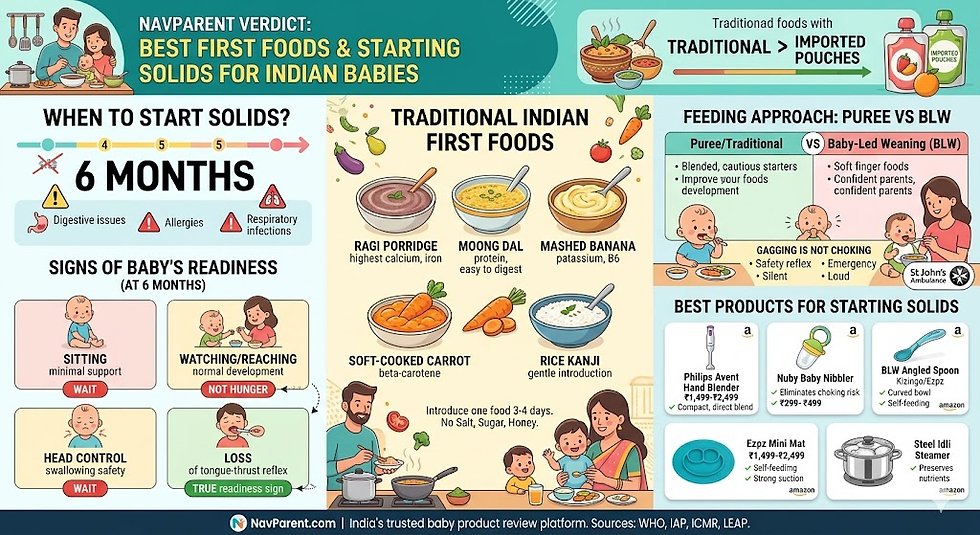
WHO and the Indian Academy of Pediatrics both recommend exclusive breastfeeding until six completed months (180 days), then complementary feeding alongside continued breastfeeding. Not before — an earlier start raises infection and allergy risk without any growth benefit.
Signs your baby is actually ready (all four should be present):
• Sits with minimal support and holds her head steady
• Has lost the tongue-thrust reflex — she doesn't automatically push food back out
• Shows genuine interest in your plate, not just curiosity about the object
• Can move food from the front to the back of her mouth
What to start with — the honest Indian answer
The Western default is single-grain rice cereal. In India, rice-first is a weaker choice, because polished rice is low in iron and Indian infant anaemia rates are very high. Better first foods:
Food | Why it earns its place |
Ragi (finger millet) porridge | Calcium and iron; traditional, cheap, well tolerated |
Moong dal water, then mashed dal | Protein and iron; the classic Indian first food for good reason |
Mashed sweet potato / pumpkin | Sweet, easy, vitamin A |
Mashed banana, chikoo, papaya | Ready-made purée, no cooking |
Well-mashed khichdi (no salt, no chilli) | From ~7 months — protein + carb in one |
Puréed palak or methi with dal | Iron; introduce after single foods are tolerated |
Rules for the first month of solids:
• One new food every 3 days. If there's a reaction, you'll know what caused it.
• Start with 1–2 teaspoons once a day. By 7 months, aim for two meals.
• No salt and no sugar before 12 months. Infant kidneys can't handle the sodium load, and added sugar sets taste preferences early.
• No honey before 12 months — infant botulism risk. This includes honey on the lips, and includes janam ghutti preparations containing honey.
• No cow's milk as a drink before 12 months (as an ingredient in cooking, it's fine from ~8 months). It displaces iron absorption and can cause micro-bleeding in the infant gut.
• Milk still leads. Breast milk or formula remains the main nutrition source until 12 months. Solids are practice, not replacement.
The iron problem nobody warns Indian parents about
This is the most important paragraph on this page.
A baby is born with iron stores that last roughly six months. At six months those stores run down, and dietary iron has to take over. India has one of the world's highest childhood anaemia burdens — the last National Family Health Survey found roughly two in three children aged 6–59 months were anaemic.
What this means practically:
• Prioritise iron-rich first foods (ragi, dal, greens, and for non-vegetarian families, well-mashed egg yolk from ~7 months and finely minced meat/liver from ~8 months)
• Pair iron with vitamin C — a squeeze of lemon or a bit of amla, tomato or guava with an iron-rich meal meaningfully improves absorption
• Keep tea and milk away from meals; both inhibit iron absorption
• Ask your paediatrician about iron supplementation. Many Indian paediatricians start prophylactic iron at six months. Don't self-dose — get the dose from your doctor.
Vitamin D: IAP recommends continued supplementation (commonly 400 IU/day) through infancy. Indian sunlight does not reliably solve this — urban air quality, indoor living, clothing coverage and darker skin all reduce cutaneous synthesis. If you stopped the drops, restart after checking with your doctor.
Annaprashan: timing it with the medical advice
Annaprashan — the first-rice ceremony — usually falls close to six months, which lines up well with the medical recommendation. Timing customs vary by community; the most widely followed convention is even months for boys (6th or 8th) and odd months for girls (5th or 7th), with families choosing a muhurat within that window. Bengali families call it Mukhe Bhaat, Tamil families Annaprasana, Telugu families do Annaprasana after Barasala, and in Kerala the equivalent is Choroonu.
Two practical notes:
• If tradition puts the ceremony at five months, treat the ceremonial spoonful as ceremonial. Full complementary feeding still starts at six completed months.
• Ceremony food is usually payasam or sweetened rice. A single ritual taste is fine; don't let it become the pattern. No added sugar before 12 months still holds the next day.
Full ritual guide, samagri checklist and regional variations: [Annaprashan Ceremony Guide →]
Vaccines due around 6 months
Under the IAP schedule, the six-month visit commonly includes Hepatitis B (third dose), OPV, and the first dose of influenza vaccine — with a second influenza dose four weeks later. Rotavirus and PCV schedules vary depending on which brand and schedule your paediatrician started at 6/10/14 weeks.
Schedules differ between the Government of India's UIP and the IAP recommended schedule, and between individual practices. Take your MCP card to the visit and confirm what's due with your paediatrician rather than working from any website, including this one.
Plan the full schedule: NavParent Vaccination Scheduler →
Sleep at six months
Typical: 12–15 hours total, with 2–3 naps and one long night stretch that may or may not be unbroken. Night waking at six months is normal and not a sign you've done something wrong.
On bedsharing — most Indian families bedshare, and blanket Western advice to never do it isn't useful here. If you bedshare, reduce the risk: firm mattress, no pillows or loose blankets near the baby, no gaps between mattress and wall, baby on her back, no bedsharing if either parent smokes, has been drinking, has taken sedating medication, or is severely sleep-deprived. Sofas and armchairs are genuinely dangerous for shared sleep — never there.
What's actually worth buying this month
Item | ₹ range | Verdict |
Steel or silicone bowl + soft-tip spoon | ₹300–800 | Buy. A flat-bottomed steel katori and a silicone-tip spoon is all you need. Skip the ₹2,000 sets. |
High chair or floor seat with 5-point harness | ₹2,500–8,000 | Buy. Not for luxury — for safety. Never feed a baby on a lap or a bed; both raise choking risk. A booster with a harness on a dining chair works in a small flat. |
Silicone bib with a catch pocket | ₹250–600 | Buy. Wipes clean, catches the 60% that misses. |
Sippy or open cup | ₹200–500 | Buy. Introduce water in a cup with meals now. Skip spouted no-spill valves — they work like a bottle. |
Baby food processor | ₹2,000–5,000 | Skip. Your existing mixer and a fork do this. |
Mesh/silicone feeder | ₹200–400 | Optional. Useful for teething relief with cold fruit; not a feeding tool. |
Packaged infant cereals | ₹250–500 | Mostly skip. Home-made ragi and dal are cheaper, fresher and often better on iron. Useful for travel. |
If it were our money: a ₹400 steel bowl-and-spoon set, a ₹3,000 harnessed booster seat, a ₹300 silicone bib, and the rest spent on actual groceries.
Red flags — call your paediatrician
Sign at 6 months | Why it matters |
Not rolling in either direction | Possible motor delay |
Doesn't reach for or grasp objects | Motor / vision assessment needed |
No babbling or vocal sounds at all | Hearing and speech assessment |
Doesn't turn towards sounds or voices | Hearing screen |
Very stiff or very floppy muscle tone | Neurological assessment |
No social smile, no eye contact | Developmental assessment |
Not gaining weight, or crossing downwards through growth centiles | Feeding and nutrition review |
Eyes not tracking together, or persistent squint | Ophthalmology referral |
Premature babies should be assessed on corrected age, not birth age. A baby born at 32 weeks is developmentally closer to four months at six months old, and that's expected.
Frequently asked questions
Can I start solids at 4 months? My mother says we all started at 3.
The evidence changed for good reason. Earlier starts are associated with more infections and no growth advantage, and infant gut and kidney maturity at four months isn't there yet. Six completed months is the WHO and IAP recommendation. If your baby is genuinely not gaining weight, that's a medical conversation, not a reason to start early on your own.
Is gripe water or janam ghutti safe?
Neither is recommended. Formulations vary wildly, many are unregulated, some historically contained alcohol or sodium bicarbonate, and honey-containing preparations carry infant botulism risk under 12 months. If your baby has colic or reflux, talk to your paediatrician about what's actually going on.
My baby gags on everything. Is she choking?
Gagging is a normal, protective reflex and it looks alarming. The baby is noisy, red-faced and pushing food forward. Choking is silent — no sound, no crying, no effective cough. Learn the difference, and do an infant first-aid/CPR session before you start solids. Every parent should.
Should I do baby-led weaning or purées?
Both work. BLW needs confident sitting, appropriately shaped soft foods (finger-length strips, not coins or rounds), and constant supervision. Purées are easier to control for iron content. Most Indian families do a mix, which is fine.
How much water now?
Small amounts with meals — roughly 30–60 ml a day at six months, from an open or straw cup. Water shouldn't displace milk feeds.
💡 NavParent Tool — Check what vaccines are due for your baby's exact date of birth → Vaccination Scheduler |
Sources & references
• Indian Academy of Pediatrics — Immunization Timetable and Infant & Young Child Feeding guidance
• WHO — Complementary feeding recommendations for infants 6–23 months
• National Family Health Survey (NFHS-5) — childhood anaemia prevalence, India
• ICMR-NIN — Dietary Guidelines for Indians
• CDC/AAP — Developmental milestone surveillance framework (2022 revision)
Medical disclaimer: This article is general information, not medical advice for your individual child. Always consult your paediatrician.


Comments